
I’ve noticed something interesting over the past few years. When we talk about sustainability, the conversation almost always revolves around reducing: reduce plastic, reduce waste, reduce emissions, reduce consumption… And while every one of those things matters, I’ve often found myself wondering whether we’ve become so focused on minimising harm that we’ve forgotten to ask a different question altogether. What if sustainability wasn’t only about taking less? What if it could also be about giving something back?
That, to me, is where regenerative farming becomes so interesting. Rather than asking how we can simply reduce our impact on the environment, it asks whether agriculture can actively restore the ecosystems it depends on. It’s not just another farming method or environmental buzzword, but a different way of thinking about our relationship with the land. Instead of focusing solely on producing food while minimising environmental harm, regenerative farming asks a far more ambitious question: can the way we grow our food improve soil health, increase biodiversity, protect waterways and leave the land healthier than we found it?
I think that’s why the idea feels so refreshing. Environmental stories are often dominated by what we’re losing: wildlife, healthy soils, habitats and a stable climate. While those challenges are very real, regenerative farming reminds us that nature isn’t only something to protect from further harm; it’s also something with an extraordinary capacity to recover when given the chance. By working with natural systems rather than against them, farming has the potential to become part of that recovery. For me, that’s what makes regenerative farming such a hopeful idea. It shifts the conversation from simply limiting damage to creating landscapes that are richer, healthier and more resilient for the future.
What actually is regenerative farming
One of the reasons regenerative farming can feel difficult to define is that it isn’t a single farming method. It’s better understood as a philosophy rather than a technique.
That’s partly because regenerative farming isn’t defined by a rigid set of rules or a certification that every farmer follows. Instead, it’s guided by a series of principles and, perhaps more importantly, by the outcomes those principles are intended to achieve. Every farm is different, so regenerative practices vary according to the landscape, climate and crops being grown. What matters is whether those decisions improve soil health, support biodiversity, strengthen ecosystems and leave the land in a better condition over time.
Instead of seeing soil as something crops simply grow in, it views soil as a living ecosystem. Instead of treating wildlife as separate from farming, it recognises that healthy ecosystems support healthy harvests. Instead of working against natural processes, it tries to work alongside them.
The aim isn’t only to produce food, although that’s still incredibly important. It’s also to rebuild soil health, encourage biodiversity, improve water retention, strengthen ecosystems and create farms that become more resilient over time. I think what appeals to me most is that regenerative farming acknowledges something we’ve perhaps forgotten. Nature already knows how to regenerate; forests don’t need artificial fertilisers to remain forests, wildflower meadows restore themselves season after season, and wetlands clean and filter water naturally. Healthy ecosystems have evolved over thousands of years through relationships between plants, animals, insects, fungi and microorganisms.
Regenerative farming doesn’t try to recreate wilderness, but it does ask an important question: How can agriculture learn from the systems that nature has already perfected?
Related –

IT ALL STARTS UNDERGROUND
Whenever we think about nature, our eyes naturally drift upwards. We notice towering trees, colourful flowers, birds crossing the sky or bees moving between blossoms. Rarely do we think about what’s happening beneath our feet. Yet some of the most extraordinary activity on Earth is taking place just below the surface.
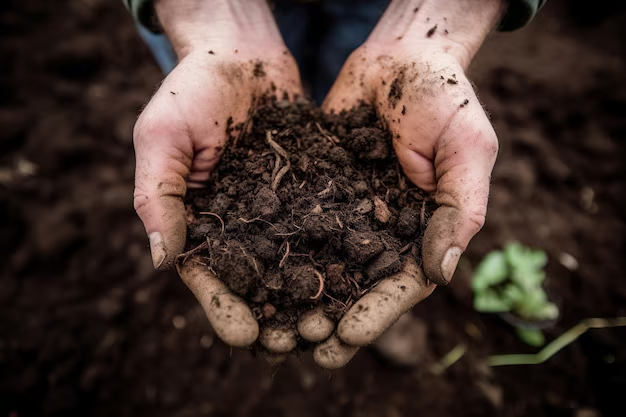
Healthy soil is astonishingly alive. That’s one of the central ideas behind regenerative farming. Rather than treating soil as an inert growing medium, it recognises it as a complex living ecosystem. The healthier that underground community becomes, the more effectively it can cycle nutrients, retain water, store carbon and support resilient crops above the surface. A single teaspoon can contain billions of microorganisms, alongside fungi, bacteria, insects, earthworms and countless other tiny forms of life, all working together in ways we’re still only beginning to understand. It’s less like dirt and more like a hidden city.
These microscopic communities recycle nutrients, break down organic matter, create pathways for water, support plant roots and even help store carbon from the atmosphere. Without healthy soil, almost every ecosystem on Earth begins to struggle: Plants become weaker, water runs off rather than soaking into the ground, wildlife loses habitat, and crops become increasingly dependent on artificial inputs.
Related – Celebrating 10 Years of World Soil Day
Everything Begins with Healthy Soil
The more I learned about soil, the more amazed I became by how little attention it receives. It’s easy to overlook because it’s always there, but perhaps that’s exactly why it’s so remarkable. Healthy soil quietly supports almost everything else: The food we eat, the landscapes we enjoy, the insects that pollinate our crops, the rivers that flow through our countryside. Even the air we breathe is connected, in some way, to the health of the ground beneath us.
Regenerative farming begins with recognising that relationship. It understands that if we care for the soil, the soil is remarkably capable of caring for everything that grows above it. There’s something beautifully humbling about that.
WHY MODERN FARMING CHANGED EVERYTHING
Whenever we talk about regenerative farming, it’s easy to fall into the trap of imagining that modern agriculture somehow “got it wrong”. I don’t think that’s a particularly helpful way of looking at it.
To understand why farming looks the way it does today, we have to remember the challenges previous generations were facing. Throughout the twentieth century, populations were growing rapidly. Countries needed to produce more food than ever before, often with fewer people working on the land. Mechanisation, synthetic fertilisers, pesticides and larger-scale farming all helped increase yields dramatically, making food more abundant and, in many cases, more affordable.
Those advances changed lives. For millions of people around the world, they improved food security and helped reduce hunger, and it’s important to acknowledge that. But every solution brings new questions. Over time, researchers began noticing that some intensive farming practices were also creating unintended consequences. Repeatedly growing the same crops in the same fields could reduce biodiversity, and frequent ploughing disturbs soil structure. Heavy reliance on synthetic fertilisers and pesticides sometimes affects surrounding ecosystems, waterways and wildlife. Gradually, the living complexity of soil itself became easier to overlook.
What had once been understood as a living ecosystem was increasingly treated as a surface to manage. That doesn’t mean modern farming is inherently harmful, nor does it suggest that every farm operates in the same way. Agriculture today is incredibly diverse, and many farmers have been adapting their practices for years in response to new research, changing climates and a growing understanding of ecology.
Working With Nature, Not Against It
In many ways, regenerative farming isn’t about rejecting modern agriculture. It’s recognising that producing food and restoring nature don’t have to exist at opposite ends of the conversation. Perhaps they can support one another instead, and I find that a much more hopeful way of thinking about the future.
In brief, the goal of regenerative farming is to combine generations of farming knowledge with a deeper appreciation of how living systems actually work. The more I explore this topic, the more it feels less like a trend and more like a quiet shift in perspective. One that begins, quite literally, from the ground up.

THE DIFFERENCE BETWEEN SUSTAINABLE AND REGENERATIVE
As I was writing this article, I kept coming back to two words that are often used almost interchangeably: *sustainable* and *regenerative*. But the more I thought about them, the more I realised they aren’t quite the same.
Sustainability, at its heart, asks an incredibly important question: How can we meet our needs today without compromising the ability of future generations to meet theirs? It’s a philosophy centred around balance. Around reducing harm, protecting resources and ensuring that what exists today can continue to exist tomorrow.
Regeneration begins from a slightly different place. Rather than asking how we maintain something, it asks whether we can help it become healthier than it was before. That feels like such a hopeful shift in perspective.
Protecting Nature or Restoring It?
Imagine walking through a woodland. A sustainable approach might focus on protecting it from further damage, making sure it remains healthy for years to come. A regenerative approach would ask another question alongside it: How can we restore the parts that have already been lost? How can we encourage wildlife to return? Improve the health of the soil? Plant native species? Allow the ecosystem to become richer over time?
Neither approach is better than the other. In fact, I think they complement each other beautifully. But I do think regeneration adds something we’ve perhaps been missing from environmental conversations: Optimism. It reminds us that nature has an extraordinary capacity to recover when we give it the opportunity. And perhaps that’s a message many of us need to hear.

SO WHAT DOES REGENERATIVE FARMING ACTUALLY LOOK LIKE?
Once I understood the philosophy behind regenerative farming, I became curious about what it actually looks like in practice. Interestingly, there isn’t a universal checklist. Every farm is different, shaped by its landscape, climate, crops and wildlife. That means regenerative farming often looks slightly different from one place to the next.
But there are some principles that appear again and again. One of them is keeping the soil covered wherever possible. Rather than leaving fields bare between harvests, many regenerative farmers plant what are known as cover crops. These plants help protect the soil from erosion, improve its structure, retain moisture and provide food for microorganisms throughout the year. When they’re eventually returned to the soil, they also contribute valuable organic matter that continues feeding the ecosystem below ground.
Although no two regenerative farms look exactly alike, many are guided by the same core principles. These include disturbing the soil as little as possible, keeping it covered throughout the year, maintaining living roots in the ground, encouraging greater biodiversity and, where appropriate, integrating livestock into the landscape. Together, these approaches aim to support the natural processes that healthy ecosystems rely on.

CROP ROTATION
Crop rotation is another long-established practice that’s become central to regenerative farming. By growing different crops in the same field over time, farmers naturally replenish nutrients, reduce pests and diseases, and encourage a greater diversity of life both above and below the surface.
Many farms also reduce how often they disturb the soil through intensive ploughing. Healthy soil develops intricate networks of fungi, roots and microorganisms that take years to establish. Limiting disruption allows those communities to continue doing the quiet work that supports plant growth naturally.
Then there are the hedgerows. I don’t think I’d ever really appreciated just how important they are until I started researching more about nature and sustainable living. Time and again, they’ve appeared as one of the quiet heroes of healthy ecosystems, supporting wildlife, protecting soils and connecting habitats in ways that are easy to overlook.
Related: Foraging |No Mow May | Pollinators | Biodiversity

Regenerative farmers often protect or restore these living boundaries because they’re far more than field dividers. They provide shelter for birds, homes for insects, food for mammals and safe corridors that allow wildlife to move across the landscape.
Some farms also integrate trees alongside crops or livestock, creating systems where different species support one another naturally. Others rotate grazing animals carefully across fields, allowing grasslands time to recover while returning nutrients to the soil.
None of these practices exists in isolation; they’re all connected by one simple idea. Healthy ecosystems tend to become more resilient when we allow nature to do more of what it has always done.

CAN REGENERATIVE FARMING REALLY HELP CLIMATE CHANGE?
Whenever a new environmental idea becomes popular, it’s tempting to present it as a silver bullet. Regenerative farming isn’t one. Climate change is an incredibly complex challenge, and no single solution will solve it on its own. But regenerative farming can absolutely become part of a much bigger picture. Its greatest strength may be that many of its benefits overlap. Practices that build healthier soils don’t just help store more carbon; they can also improve water infiltration, reduce erosion, support wildlife and make farms more resilient to both drought and flooding. Rather than solving one environmental problem in isolation, regenerative farming seeks to improve the health of the entire system.
Healthy soils naturally store significant amounts of carbon through plant roots and organic matter. By improving soil health, regenerative practices can help increase the amount of carbon that remains locked underground rather than returning to the atmosphere.
At the same time, healthier soils behave differently during extreme weather. They absorb rainfall more effectively, reducing flood risk. They retain moisture for longer during dry periods, helping crops become more resilient as weather patterns become increasingly unpredictable. These aren’t dramatic overnight changes, but gradual improvements that accumulate over years, sometimes decades.

Regenerative farming is about more than producing food sustainably—it’s about restoring the health of the land. By improving soil, encouraging biodiversity and working alongside natural processes, it aims to leave ecosystems healthier and more resilient for future generations.